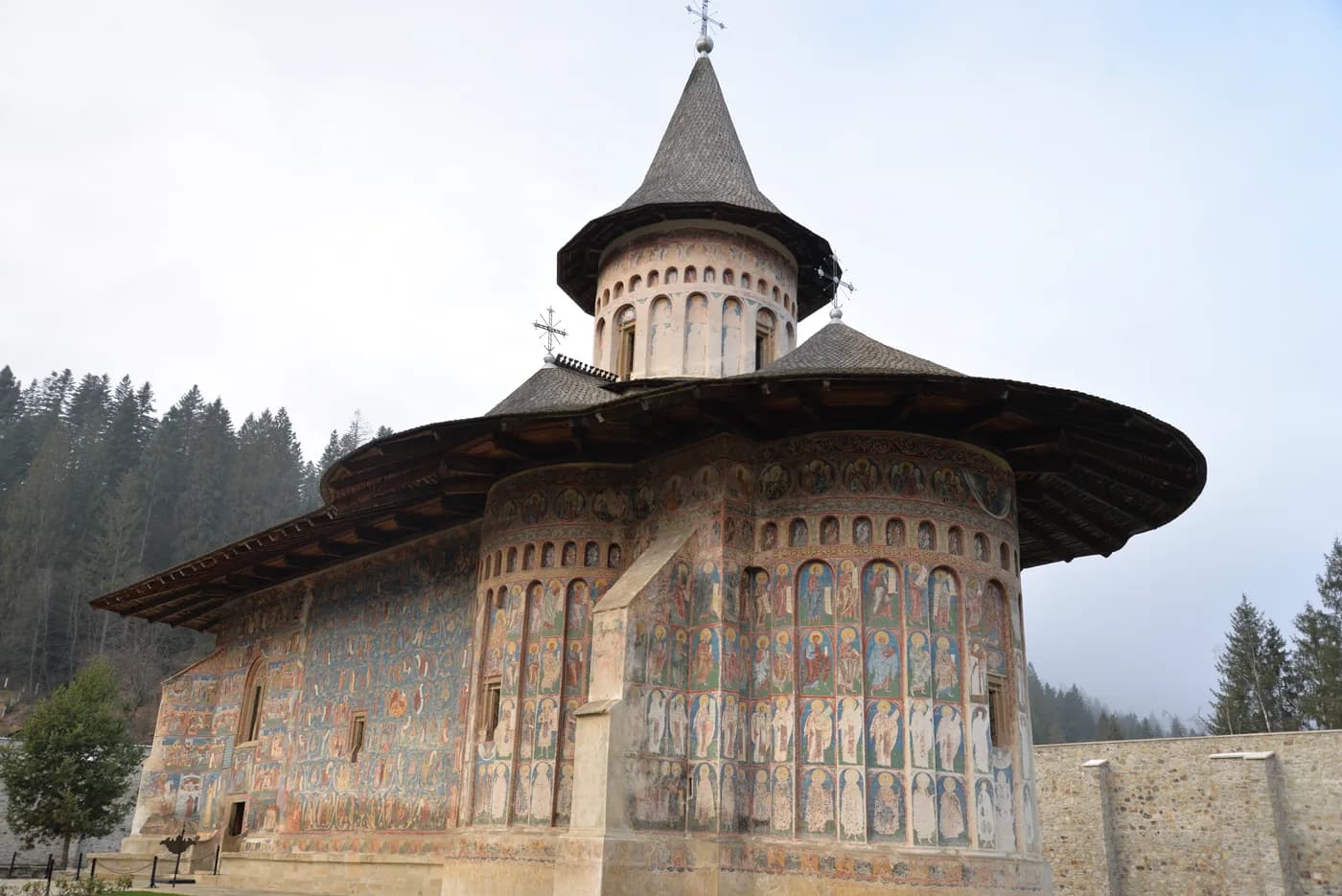
The outside wall of Voroneț monastery, covered in fifteenth-century frescoes

Bucovina

In the north of the country, a handful of small monastery churches are painted on the outside, wall to wall, with scenes that were meant to be read by people who could not read. They have stood in the open for five hundred years and the colours are still there.

What you see in Bucovina

Voroneț

The one people come for. Built in 1488 under Stephen the Great, and painted a few decades later on every outside wall. The blue of its background has a name of its own — Voroneț blue — and nobody has quite reproduced it since. The west wall carries a Last Judgement that runs from the roof to the ground.

Sucevița, Moldovița, Humor

Each one is different, and none takes long to see, which is why they are visited together. Sucevița is the largest and still has its walls and towers; Moldovița has a siege of Constantinople painted across one side; Humor is the smallest and the quietest of the four. Several of the churches here are on the UNESCO World Heritage list.

The rest of the day

Bucovina is not only churches. Black pottery is still fired at Marginea the way it has been for centuries, there is a narrow-gauge steam train that runs up a forest valley, and the villages keep costumes and customs that are worn rather than displayed.

Practical notes

  • Bucovina is in the far north. From Bucharest the drive takes the best part of a day, so it belongs in a longer tour rather than a day trip.
  • Three days is a sensible minimum: one to get there, one for the monasteries, one for the villages and the road back.
  • The churches are working monasteries. Shoulders and knees covered, and quiet inside.
  • Late spring and early autumn have the best light on the frescoes. Winter is beautiful and cold, and some mountain roads close.

Nothing here is a fixed package. Tell us how many days you have and what you want to see, and we will put a route together. Ask for a quote.

💬 Ana · online